


Burgundy
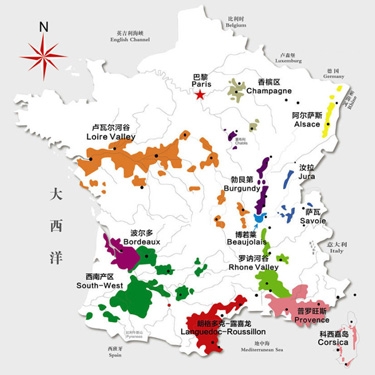
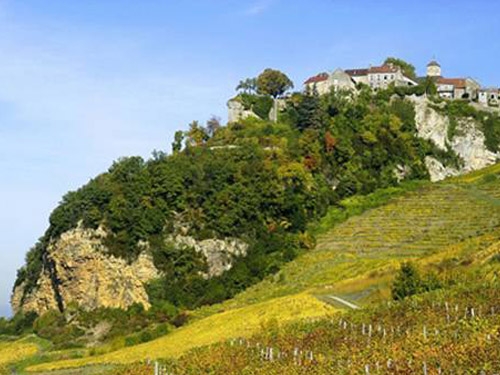
Burgundy wine (French: Bourgogne or vin de Bourgogne) is wine made in the Burgundy region in eastern France, in the valleys and slopes west of the Saône, a tributary of the Rhône. The most famous wines produced here—those commonly referred to as "Burgundies"—are dry red wines made from Pinot noir grapes and white wines made from Chardonnay grapes.
Red and white wines are also made from other grape varieties, such as Gamay and Aligoté, respectively. Small amounts of rosé and sparkling wines are also produced in the region.
Burgundy has a higher number of appellations d'origine contrôlée (AOCs) than any other French region, and is often seen as the most terroir-conscious of the French wine regions. The various Burgundy AOCs are classified from carefully delineated Grand Cru vineyards down to more non-specific regional appellations. The practice of delineating vineyards by their terroir in Burgundy goes back to medieval times, when various monasteries played a key role in developing the Burgundy wine industry.
Burgundy is home to some of the most expensive wines in the world, including those of Domaine de la Romanée-Conti, Domaine Leroy, Henri Jayer. However, some top vintage first growth Bordeaux wines are more expensive than some Grand Cru class Burgundies.
Geography and climate
The Burgundy region runs from Auxerre in the north to Mâcon in the south.
Southeast of Chablis is the Côte d'Or, where Burgundy's most famous and most expensive wines originate, and where all Grand Cru vineyards of Burgundy (except for Chablis Grand Cru) are situated. The Côte d'Or itself is split into two parts: the Côte de Nuits which starts just south of Dijon and runs till Corgoloin, a few kilometers south of the town of Nuits-Saint-Georges, and the Côte de Beaune which starts at Ladoix and ends at Dezize-les-Maranges. The wine-growing part of this area in the heart of Burgundy is just 40 kilometres (25 mi) long, and in most places less than 2 kilometres (1.2 mi) wide. The area is made up of tiny villages surrounded by a combination of flat and sloped vineyards on the eastern side of a hilly region, providing some rain and weather shelter from the prevailing westerly winds. The best wines - from Grand Cru vineyards - of this region are usually grown from the middle and higher part of the slopes, where the vineyards have the most exposure to sunshine and the best drainage. The Côte de Nuits contains 24 out of the 25 red Grand Cru appellations in Burgundy, while all but one of the region's white Grand Cru wines are in the Côte de Beaune. This is explained by the presence of different soils, which favour Pinot noir and Chardonnay, respectively.
Further south is the Côte Chalonnaise, where again a mix of mostly red and white wines are produced, although the appellations found here such as Mercurey, Rully and Givry are less well-known than their counterparts in the Côte d'Or.
Below the Côte Chalonnaise is the Mâconnais region, known for producing large quantities of easy-drinking and more affordable white wine. Further south again is the Beaujolais region, famous for fruity red wines made from Gamay grapes.
Burgundy experiences a continental climate characterized by cold winters and hot summers. The weather is very unpredictable, with rains, hail, and frost all possible around harvest time. Because of this climate, vintages from Burgundy vary considerably.
Grape varieties
Of the white grapes, Chardonnay is the most common. Another grape found in the region, Aligoté, tends to produce cheaper wines which are higher in acidity. Sauvignon blanc is also grown in the Saint Bris appellation. Chablis, Mâcon wines and the Côte d'Or whites are mostly produced from 100% Chardonnay grapes.
Of the red grapes, the majority of production in the Côte d'Or is focused on the Pinot noir grape, while the Gamay grape is grown in Beaujolais. In the Côte de Nuits region, 90% of the production is red grapes.
History
Archaeological evidence establishes viticulture in Burgundy as early as the second century AD, although the Celts may have been growing vines in the region previous to the Roman conquest of Gaul in 51 BC. Greek traders, for whom viticulture had been practiced since the late Neolithic period, had founded Massalía in about 600 BC, and traded extensively up the Rhône valley, where the Romans first arrived in the second century BC. The earliest recorded praise of the wines of Burgundy was written in 591 by Gregory of Tours, who compared it to the Roman wine Falernian.
Monks and monasteries of the Roman Catholic Church have had an important influence on the history of Burgundy wine. The influence of the church became important in Charlemagne's era. The Benedictines, through their Abbey of Cluny founded in 910, became the first truly big Burgundy vineyard owner over the following centuries. The Cistercians created Burgundy's largest wall-surrounded vineyard, the Clos de Vougeot, in 1336. More importantly, the Cistercians, extensive vineyard owners as they were, were the first to notice that different vineyard plots gave consistently different wines. They therefore laid the earliest foundation for the naming of Burgundy crus and the region's terroir thinking.
Since Burgundy is land-locked, very little of its wine left the region in Medieval times, when wine was transported in barrels, meaning that waterways provided the only practical means of long-range transportation. The only part of Burgundy which could reach Paris in a practical way was the area around Auxerre by means of the Yonne. These wines first became famous in the 14th century, during the Babylonian Captivity of the Papacy in Avignon, which was reachable by Saône and Rhône after some overland transport.
In the 18th century, the quality of roads in France became progressively better, which facilitated commerce in Burgundy wines. The first négociant houses of the region were established in the 1720s and 1730s. In the 18th century, Burgundy and Champagne were rivals for the lucrative Paris market, to which Champagne had earlier access.
After Burgundy became incorporated in the Kingdom of France, and the power of the church decreased, many vineyards which had been in the church's hands were sold to the bourgeoisie from the 17th century. After the French revolution of 1789, the church's remaining vineyards were broken up and from 1791 sold off.
Wine classification
Burgundy is in some ways the most terroir-oriented region in France; immense attention is paid to the area of origin, and in which of the region's 400 types of soil a wine's grapes are grown. As opposed to Bordeaux, where classifications are producer-driven and awarded to individual chateaux, Burgundy classifications are geographically-focused. A specific vineyard or region will bear a given classification, regardless of the wine's producer. This focus is reflected on the wine's labels, where appellations are most prominent and producers' names often appear at the bottom in much smaller text.
The main levels in the Burgundy classifications, in descending order of quality, are: Grand crus, Premier crus, village appellations, and finally regional appellations.
Grand Cru
Grand Cru wines are produced from the small number of the best vineyard sites in the Côte d'Or, as strictly defined by the AOC laws. These Cru wines make up 2% of the production at 35 hl/ha, and are generally produced in a style meant for cellaring, and typically need to be aged a minimum of five to seven years. The best examples can be kept for more than 15 years. Grand Cru wines will only list the name of the vineyard as the appellation - such as Corton or Montrachet - on the wine label, plus the Grand Cru term, but not the village name.
Premier Cru
Premier Cru wines are produced from specific vineyard sites that are still considered to be of high quality, but not as well regarded as the Grand Cru sites. Premier Cru wines make up 12% of production at 45 hl/ha. These wines often should be aged three to five years, and again the best wines can keep for much longer. Premier Cru wines are labelled with the name of the village of origin, the Premier Cru status, and usually the vineyard name, for example, "Volnay 1er Cru Les Caillerets". Some Premier Cru wines are produced from several Premier Cru vineyards in the same village, and do not carry the name of an individual vineyard.
Village
Village appellation wines are produced from a blend of wines from supposedly lesser vineyard sites within the boundaries of one of 42 villages, or from one individual but unclassified vineyard. Wines from each different village are considered to have their own specific qualities and characteristics, and not all Burgundy communes have a village appellation. Village wines make up 36% of production at 50 hl/ha. These wines can be consumed two to four years after the release date, although again some examples will keep for longer. Village wines will show the village name on the wine label, such as "Pommard", and sometimes - if applicable - the name of the single vineyard or climat where it was sourced. Several villages in Burgundy have appended the names of their Grand Cru vineyards to the original village name - hence village names such as "Puligny-Montrachet" and "Aloxe-Corton".
Region
Regional appellation wines are wines which are allowed to be produced over the entire region, or over an area significantly larger than that of an individual village. At the village, Premier Cru and Grand Cru levels, only red and white wines are found, but some of the regional appellations also allow the production of rosé and sparkling wines, as well as wines dominated by grape varieties other than Pinot noir or Chardonnay.
Product Center
Leave us a message

Contact Fagao China through the following methods
