


Alsace
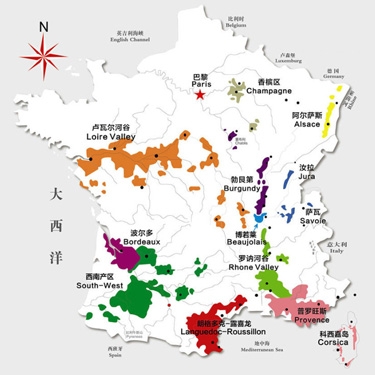
Alsace wine or Alsatian wine (in French: Vin d'Alsace) is produced in the Alsace region in France and is primarily white. Because of its Germanic influence, it is the only Appellation d'Origine Contrôlée region in France to produce mostly varietally labelled wines, typically from similar grape varieties to those used in German wine. Along with Austria and Germany, it produces some of the most noted dry Rieslings in the world as well as highly aromatic Gewürztraminer wines. Wines are produced under three different AOCs: Alsace AOC for white, rosé and red wines, Alsace Grand Cru AOC for white wines from certain classified vineyards and Crémant d'Alsace AOC for sparkling wines. Both dry and sweet white wines are produced.
In 2006, vines were grown on 15,298 hectares (37,800 acres) in 119 villages in Alsace, and 111.3 million litres of wine was produced. Of the vineyard surface, 78% was classified for the production of AOC Alsace wines, 4% for AOC Alsace Grand Cru, and 18% for AOC Crémant d'Alsace. About 90% of the wine produced is white. 25% of the production is exported, and the five largest export markets for still Alsace wine in terms of volume are Belgium, Netherlands, Germany, Denmark and the United States.
History
Wine has been part of Alsace’s history for a long time. An important influence in the history of Alsace wine has been the repeated changes of nationality of the Alsace region, which has passed from France to Germany and vice versa several times throughout history. In the early history of the Alsace wine industry, they were traded together with other German wines since Rhine provided the means to transport the wines. In much of the post–World War II era, wine styles in Alsace and Germany diverged, as Alsace wines remained fully fermented, that is dry, to a large extent because they were intended to be paired with food. In the same era, Alsace has also experienced a drive to higher quality, which led to AOC status being awarded.
Terroir
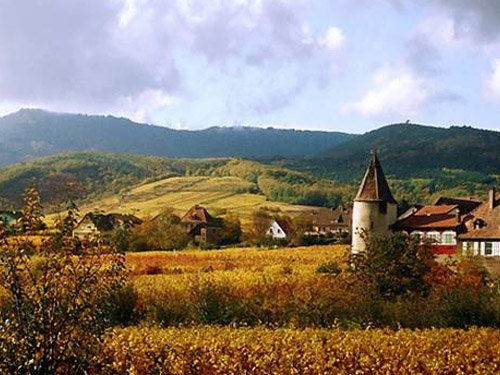
The geography of the wine growing area in Alsace is determined by two main factors, the Vosges mountains in the west and the Rhine river in the east. The vineyards are concentrated in a narrow strip, running in a roughly north-south direction, on the lower eastern slopes of the Vosges, at altitudes of 175–420 m. Those altitudes provide a good balance between temperature, drainage and sun exposure under Alsace's growing conditions. Because of predominantly westerly winds, the Vosges mountains tend to shelter Alsace from rain and maritime influence, and the region is therefore rather dry and sunny. Rainfall in Colmar is 500 mm, but can vary greatly between sites, and is the driest city in France. While the slope down the Vosges is generally east-facing, many of the best sites are south-west to south-east facing, and benefit from extra sun exposure.
Alsace's geology is quite varied, with many different kinds of soils represented in the vineyards. Alsace’s soils are a result of its location at a geological fault. Alsace as a whole is located on the western part of the Rhine Graben, which is the result of two systems of parallel faults, with a dropped down block between the Vosges and the Black Forest.
Grape Varieties
Almost all wines are white, except those made from the Pinot noir grape which are pale red, often rosé, rarely red (e.g. Rouge d'Ottrott (fr)). Much of the white wines of Alsace are made from aromatic grape varieties, which give their name to the wine they produce. Sylvaner wine is a fruity and light wine. Pinot blanc wine is subtle, fresh and supple. Riesling is a king among Alsace wines: it produces very aromatic wines with floral and mineral aromas, and is internationally known as one of the best white grape varieties. Muscat d’Alsace wine is dryer than his counterpart from other vineyards, and very fruity. Gewurztraminer wine is intense and rich. It is the most famous Alsace wine: it is powerful, spicy, strong and very aromatic.
Product Center
Leave us a message

Contact Fagao China through the following methods
